
Motivate your teams and bring out their best with data-driven evaluations.


COMPETENCY-BASED EVALUATION
Design your own competency model with flexible performance management software that adapts to your needs. Instantly spot red flags (gaps or regression) and green signals (strengths or progress) to take smart action.
Job architecture
Competency catalogs
Evaluation guides
Skill profiles
Growth and development tracking

CUSTOMIZED PERFORMANCE MODELS
Set rules and personalize every step. You're in control. Regular check-ins and feedback loops to strengthen manager–employee communication.
Evaluate based on your criteria: objectives, competencies, OKRs…
Choose who evaluates and how often: 360º, 270º, 180º, self-assessments, 1:1s, peer feedback…
Need more? Open-ended questions, automated reminders, anonymous feedback, customizable rating scales…
Too many options? Our consultants will help you define your perfect evaluation model

Predefined evaluation templates
Run evaluations with 4 preconfigured formats that cover the most common needs in talent management.
Simply choose the template that best fits your goal — monitoring, development, promotion or complete evaluation — and customize it as needed.
90º Internal: only manager — ideal for probation periods or annual reviews
180º: self-assessment + manager — perfect for continuous feedback
360º: complete evaluation (self, peers, subordinates) — support for promotions and development
Objectives + Competencies: integrated evaluation combining goals and key skills

THIS SOFTWARE IS INCLUDED IN THE CORE PACK
Professionalize talent management with tools that integrate seamlessly with our performance management software

Training Management

HR Surveys

HR Reporting Software

Organizational Chart Software

Employee Database Software
FAIR & FLEXIBLE SCORING SYSTEM
Adjust how much each evaluator impacts the final score. Is there only one main reviewer? Set it to 100%. Need multiple perspectives? For example: 80% main reviewer – 20% supporting reviewers.
Mass assignment and editing of weightings
Equal or customized scoring per evaluator
Decide whether employees can see who reviewed them

COMPETENCY MANAGEMENT
Competency-based evaluations give you deep insight into strengths and weaknesses—empowering other HR processes:
Training management: Build personalized learning plans based on skill gaps
Recruitment: Fine-tune interviews by identifying key differentiators
Employee engagement: Use survey results to justify promotions or identify issues
And more: career paths, compensation planning, succession plans, knowledge management…

COMPETENCY GAP ANALYSIS
Start by analyzing each competency's required level against the evaluation result. Then, measure deviations between expectations, actual performance, and team averages.
Spot underperformance or raw talent
Track improvement or regression
Access global reports: total achieved vs. total possible / required

OBJECTIVE-BASED EVALUATIONS
Keep your team motivated and focused with clearly defined, measurable goals (SMART).
Set a main objective (parent), link one or more related goals (children) that contribute by a specific %, and easily track their progress.
Objective tree or quarterly goal list
Real-time progress and continuous feedback for each OKR
Self-management and permissions to assign, monitor, or edit goals
Flexible child goal types: numeric, percentage-based, or achieved/not achieved

ONE-ON-ONE MEETINGS
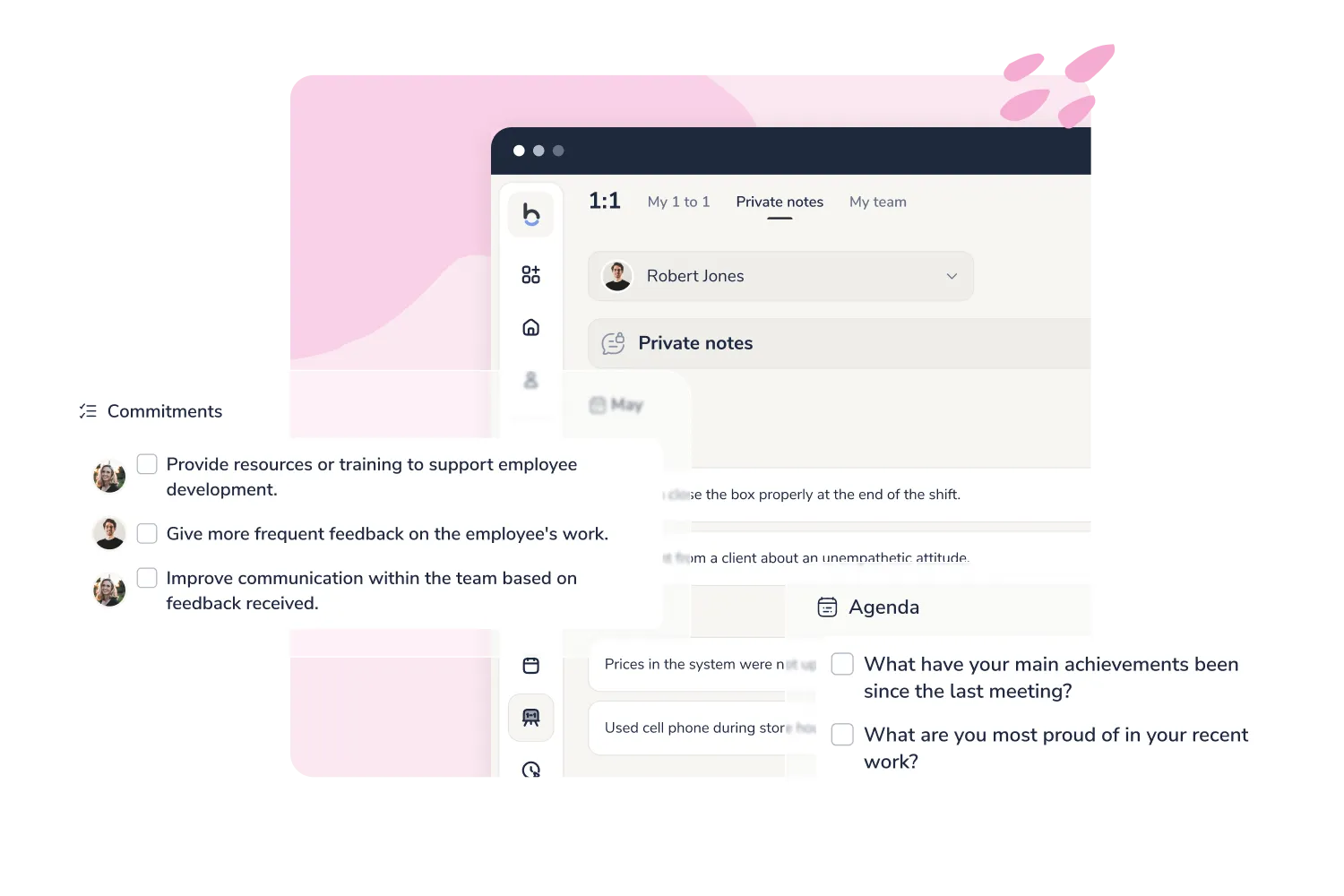
Which managers in your company actually follow up with their teams? Without a record of each meeting, the answer comes down to opinion.
Bizneo documents every session with an agenda, notes and action items assigned to the manager or the employee, linked to their goals. That way, performance reviews no longer rely on what each person remembers.
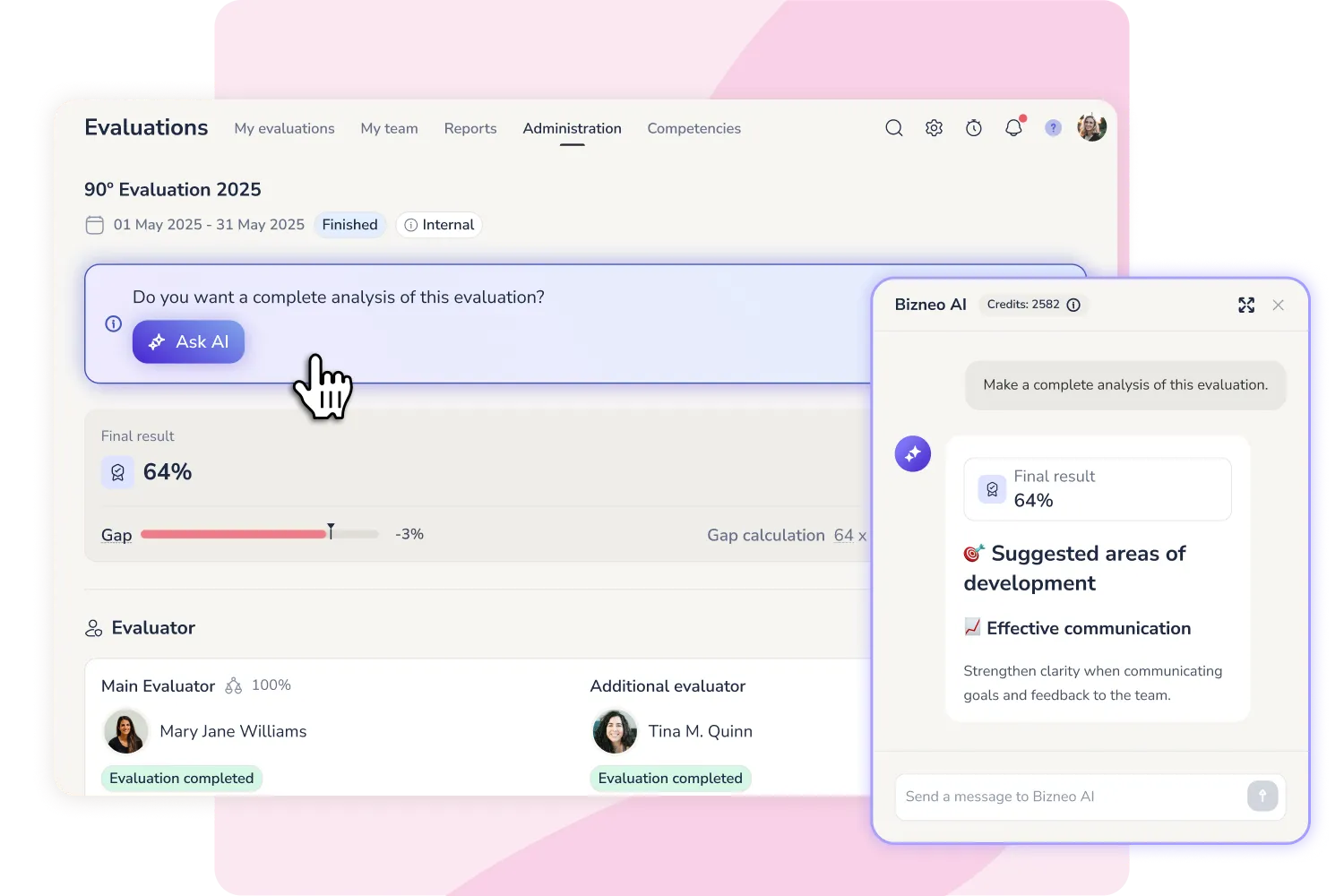
AI-powered performance review analysis
Reviewing a completed performance review manually means rereading competencies, comments and objectives to draw conclusions: time that is rarely available before the development conversation with the employee.
From the completed review form itself, the AI performs that analysis for you and provides the results without you having to interpret them.
PERFORMANCE KPIS
Generate actionable reports to support talent decisions.
Export detailed evaluation reports: comments, evaluators, required vs. actual levels, gap analysis.
Monitor progress across participants from a single dashboard
Choose whether to share comments with employees
Individual and comparative reports
Performance history and goal tracking per employee

PERFORMANCE REVIEW SIGNATURE
Once finalized, distribute the results in PDF to employees and, if desired, request their digital signature as proof of compliance or non-compliance with objectives, as well as in cases of offboarding.

TALENT MATRIX
Build customized talent matrices to identify, calibrate, and develop employee performance and potential:
9-box grid (9-grid matrix)
Potential and performance evaluations
Customizable segments and color coding

Once the evaluation is done… what’s next? Strengthen internal talent by addressing weaknesses and enhancing strengths.
Solve training needs efficiently
Track competency development over time
Monitor ROI and progress of all training initiatives

You measure your team's performance and potential (by skills, by goals or both) to make development, promotion and retention decisions based on data, not gut feeling. We cover the whole cycle: you define the model, launch the review, track who has responded, interpret the results and decide what to do with them.
You can subscribe to it on its own or together with training, surveys, reports, org charts and the employee database, which is where performance management really pays off: the gaps identified feed straight into training plans without anyone having to transfer them by hand.
By skills, by goals, by OKRs or a combination of criteria. And you define who reviews whom: 360°, 270°, 180°, self-assessment, one-to-one meetings or upward feedback from team members to their manager.
On confidentiality, which determines which formats actually work: you can anonymize responses and choose whether the person being reviewed sees who reviewed them and whether they can read the comments. Without that option, upward feedback does not produce honest results.
The right model also depends on the sector: OKR-based reviews tend to work well in tech, skills with regulatory traceability carry more weight in banking or healthcare, and in consulting it is common to review by project rather than on an annual cycle.
Yes, at several levels: job architecture, skills catalogs, competency profiles and your own review guides. Scales are fully customizable, and you can add open questions wherever you need them.
Beyond the catalog, you define your own behavior dictionary: what each level of each skill means in practice (for example, beginner, intermediate, advanced or expert), so that the same score means the same thing whoever the reviewer is, and AI suggests the wording for each level. With the job matrix, you can see at a glance which level each role requires for each skill, filtered by skill or group.
You also decide how the final score is calculated by weighting reviewers: 100% to the line manager or, for example, 80% to the main reviewer and 20% to supporting reviewers, with bulk assignment and editing of weights.
If you do not want to start from scratch, you have four ready-made templates: an internal 90° review for probation periods or annual reviews, a 180° review with self-assessment and manager, a full 360° for promotions and development, and a comprehensive template combining goals and skills.
With measurable goals organized in a tree: you set a main goal and link the goals that contribute to it, each with its contribution percentage. You can view them as a tree or as a list by quarter.
Child goals support different formats depending on what you measure: quantity, percentage or achieved/not achieved. Progress updates continuously through feedback, not just at the end of the period, and permissions define who assigns, who follows and who edits.
With automatic reminders for pending reviews and a single view where you track every participant's progress, without chasing people one by one.
Each reviewer only accesses what concerns them, and you decide how much weight their review carries in the final score. You can quickly segment audiences by any criteria you need and control whether comments are shared with the person being reviewed or kept restricted. Goal permissions are independent: who can assign them, who can only follow them and who can edit them.
While a review cycle is running, you can add new forms, so including someone who joined mid-cycle does not mean starting over, and each form can be adjusted (reviewers, questions) before it is sent. If the cycle dates change, you duplicate the process with the new dates without setting it up again.
From the completed form itself, it cross-references the assessed skills, all reviewers' comments, the employee's goals and their department in a single analysis. It identifies risks and areas for improvement and suggests development recommendations that do not always stand out on a quick read, and you can keep asking questions in the chat to dig into any result.
And before the review, it saves you the slowest part of the preparation: you select the skills and AI drafts what each level of the scale means in one go, which you then review and adapt to your company.
AI interprets and suggests; the development conversation and the decision remain with the manager. It is backed by our ISO/IEC 42001 certification for artificial intelligence management.
The gap-to-required report compares the level required for each skill with the level achieved and with the company average, and shows any change since the previous cycle: that is where you see who has a gap and who is untapped talent.
To calibrate scores across teams, the reviewer report shows the average score each manager gives, so before closing the cycle you can see whether anyone consistently scores more harshly. The individual report compares self-assessment, main reviewer and supporting reviewers, and the strengths and weaknesses report shows which skills are lacking across the whole workforce, which is where training investment makes the most sense.
Everything can be exported, and each person has a profile with their full history of reviews and goals.
Yes, with the talent map. The nine-box matrix crosses performance and potential, and each person has two further indicators: flight risk and impact of leaving. You filter for high risk and high impact, the people you cannot afford to lose, and the turnover report, which breaks down leavers by performance level, tells you whether your top performers are already walking out the door.
Performance and potential update at the end of each review, by score bands or with a balanced percentile distribution, which forces you to spread the team rather than bunch everyone into the same box. Risk and impact are assessed by the manager, with a history of every change, and if you want an objective measure, predictive turnover calculates each employee's likelihood of leaving using a model trained on your company's data: if it does not reach 80% accuracy, the module is free. Employees cannot see the map.
It is the difference between knowing how someone is performing today and how far they can go, which is what you need for succession planning and internal promotion. Do not confuse it with the job matrix: that one classifies requirements by role, while the talent map classifies people.
They turn into concrete actions across the rest of the suite. The skills gaps identified become training plans with investment tracking, and the results feed into career plans, salary reviews, succession planning and compensation plans.
For internal mobility, you have the history of role changes and a similar-roles analysis by skills that shows the percentage match with other roles. A salesperson might have an 82% match with a Sales Manager role and very little with a technical role such as developer, which requires very different skills. With that information, the career plan is built from scratch or from the moves already recorded.
For the probation period, you have a ready-made 90° template that launches automatically at the point you set after the start date, so the decision on whether a new hire stays is based on a structured review and not just the manager's impression.
You can also distribute results as PDFs to each employee's folder and, if you wish, request an e-signature, which gives documentary weight to the agreement on what was reviewed.
Like every tool in our suite, performance management starts from US$6 per employee per month. The price per employee drops when you combine it with other tools, and it works best alongside training, engagement surveys, reports or succession planning, because together they turn review results into development decisions.
Get in touch and we will prepare a quote for your team.
Start optimizing your team's performance management now